Playful Conceptualism

119 m Above Sea Level /  119 m au-dessus du niveau de la mer
6 décembre 2014 – 14 février 2015
Galerie d’art contemporain SBC Gallery of Contemporary Art
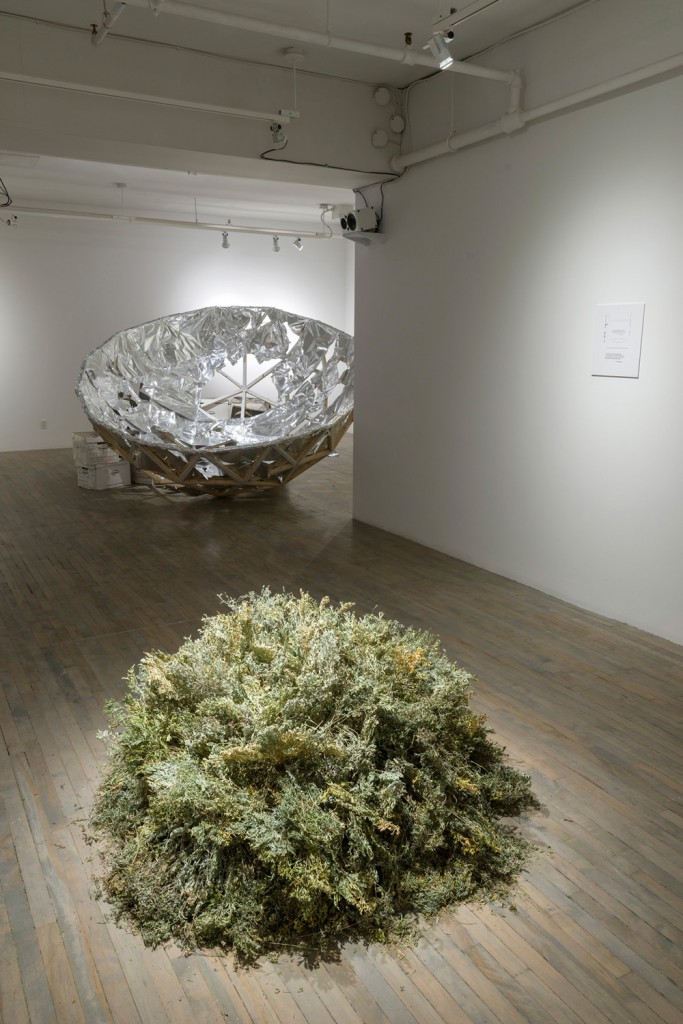
CRUM,

CRUM, “119 m Above Sea Level” (installation view), 2014. Courtesy Galerie SBC. Photo: Guy L’Heureux.

A collaborative project with the Centre de recherche urbaine de Montréal (CRUM) imaginatively restaging the lost archives of 45°30′ N-73°36’ W, an exhibition first presented at the Saidye Bronfman Center for the Arts and the Sir George Williams University Art Galleries (1971).

A review of the exhibition for Canadian Art describes the exhibition as, “peculiar, yet compelling.”
– Emily Falvey, “CRUM’s Playful Conceptualism” Canadian Art, 12 January 2015.
Peter Doig: No Foreign Lands

Montreal Museum of Fine Arts, January 24-May 4, 2014
Experience a virtual tour of the exhibition here.

An excerpt of my review of the exhibition written for C Magazine 123 (2014):

Looking at the paintings alongside my child, I was reminded that landscape is a learned pictorial convention. If visual language (like spoken language) is something we absorb from our environment, how is the Museum as the mediator of my child’s experience contributing to his nascent understanding of place? Doig’s large-scale paintings received a spacious hanging throughout the Museum’s Beaux-Arts architecture, this reinforced our contemplation of “landscape” as representations of a self-contained world existing elsewhere. However, my son’s inability to “see” the overall composition in each of Doig’s paintings meant that he focused on the fragments to which he could put words, such as “tree” or “bird.” This denaturalization of the picture caused me to wonder how Doig’s rummaging through the detritus of both a global popular culture and the global legacies of modernist painting challenge us to think of ourselves as foreign travelers in lands already occupied by other people and their memories.

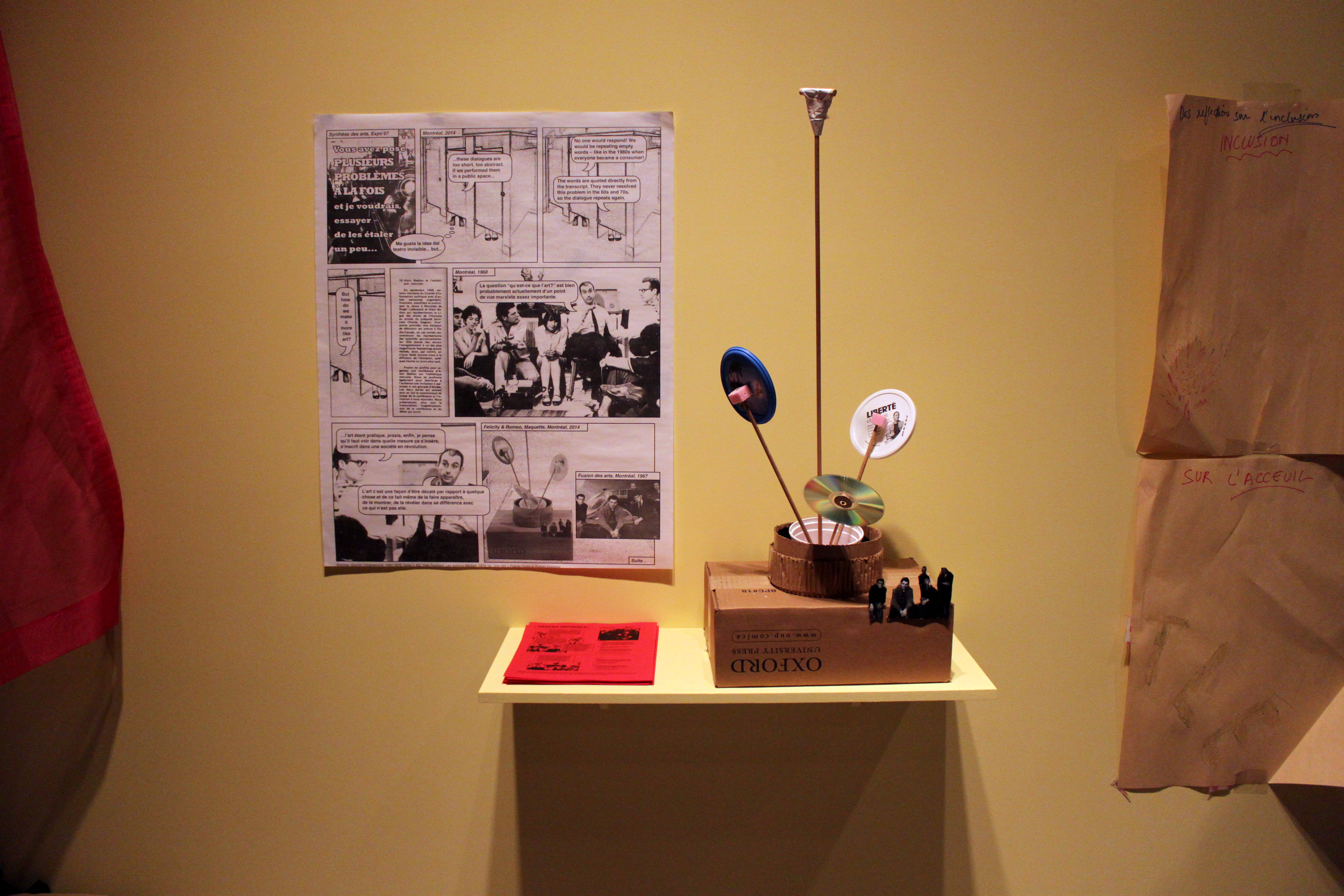
Vous avez posé plusieurs problèmes à la fois…

et je voudrais les étaler un peu…

ComicCorrected

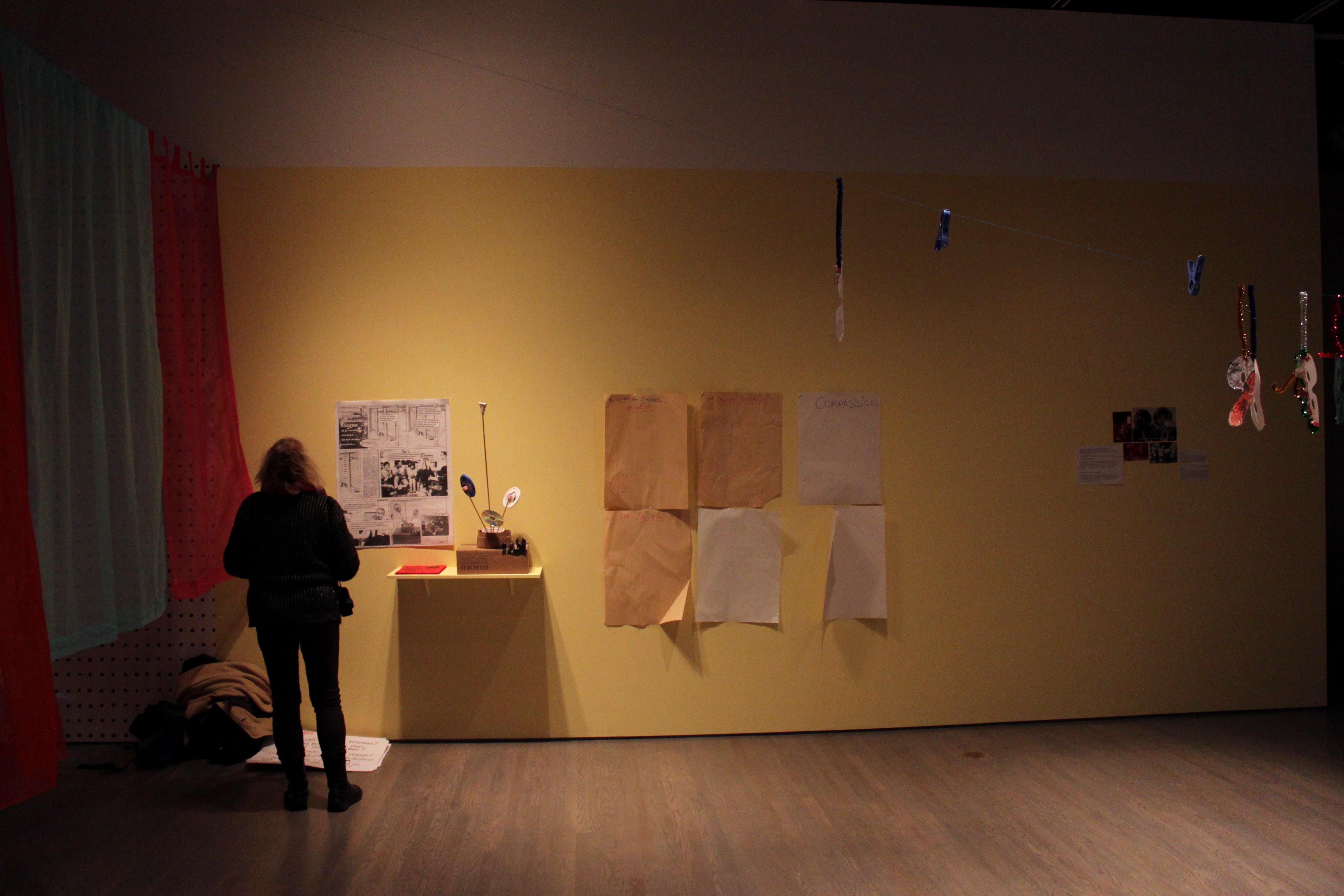
A “graphic guide” or comic book-style explanation of Marxist aesthetics created for Romeo Gongora’s project Just Watch Me. To the right, a maquette of Synthèse des Arts, 1967 by Fusion des Arts.

ComicReader

Reading the comic

The dialogue in the comic is quoted from Alain Badiou’s visit to Montreal in 1968. He gave this workshop on Marxist aesthetics at the same time that he attended the trial of “alleged separatist-terrorist leader,” Charles Gagnon, as one of two observers from the International Federation of Human Rights Leagues.

Paul-Émile Borduas A Critical Biography

By François-Marc Gagnon
Translated by Peter Feldstein
Montreal: McGill-Queen’s University Press, 2013, 596pp

Excerpted from a review written for Montreal Review of Books:

Walter Benjamin argues that a translation is the transposition of a text from one language to another as both a renewal of the original work and a revival for succeeding generations or alternate cultural contexts. With this in mind, the recent translation of François-Marc Gagnon’s biography of the celebrated modernist painter Paul-Émile Borduas offers a rich art-historical resource to a potentially global audience of English-speaking readers. At the same time, the effect of this linguistic “displacement” on our understanding of Borduas as a historical figure becomes a reoccurring theme within the content of the text itself… read more

Network Consciousness: Art Metropole (Toronto) and Residency Unlimited (Brooklyn)

Screen Shot 2014-03-20 at 11.37.50 AM

Live translation of 1973 agitprop video at Art Metropole (Toronto) alongside launch of Nathan Isbergs’ Atlantic-Griffin Manifesto, 8 February 2014

Press:
Nobu Adilman of the Toronto Eater puts the Manifesto into context with the video screening in,  The Atlantic’s Nathan Isberg Cooks Up a Manifesto .

Video screening and Q&A with Julia Oldham at RU (Brooklyn), 18 February 2014

This figure of speech has long been used to describe tangled lines of transportation or communications technologies and the people who use them to send goods and information from point to point. Because of the pervasiveness of social media, mobile phones and other technologies that augment our daily lives, we consider communications systems to mimic human behaviour and thought. By this logic, we can only perform as the technology does… read more

Watch the videos

Cette figure de style a longtemps servi à désigner l’enchevêtrement des technologies du transport et des communications, et les usagers qui les utilisent pour envoyer des biens et des informations d’un endroit à l’autre. L’omniprésence des médias sociaux, téléphones cellulaires et autres technologies qui amplifient notre vie quotidienne nous amène à considérer ces systèmes de communication comme des représentations de nos comportements et pensées. Suivant cette logique, notre productivité ne peut que refléter celle de nos technologies… lire la suite

Visioner les vidéos